Chicago News
-
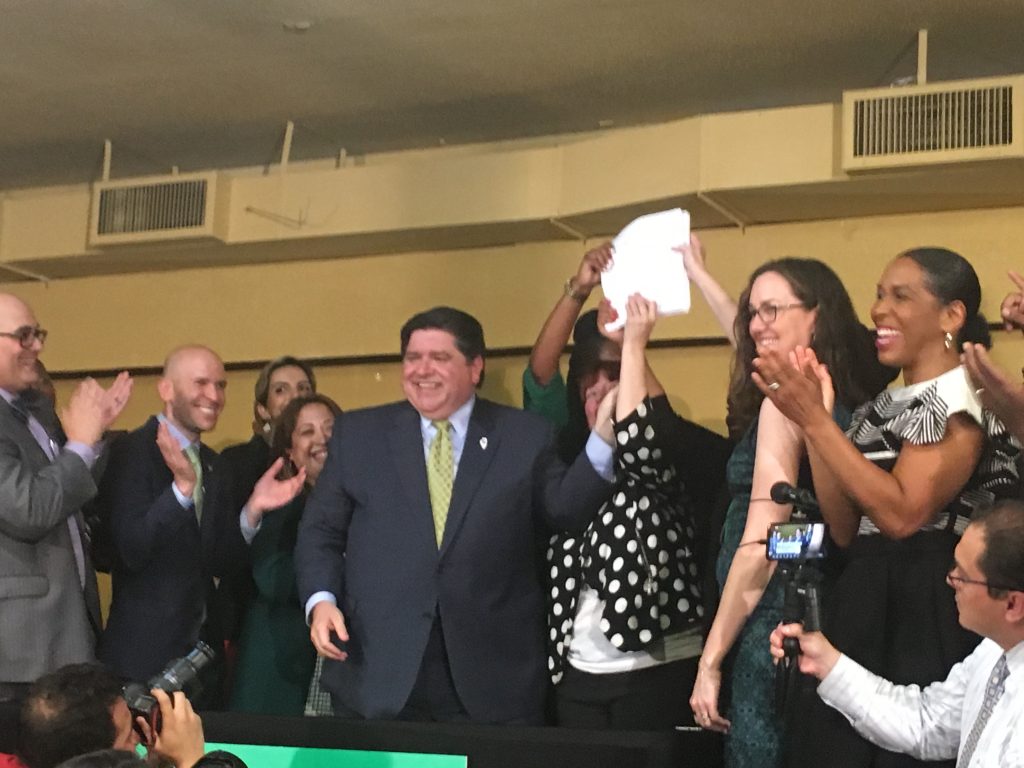
The Illinois Senate late Friday sent a measure designed to expand and protect women’s reproductive rights to Gov. JB Pritzker, who vowed to sign the measure and fulfill his promise to make Illinois the most progressive state in the nation when it comes to guaranteeing women’s reproductive rights.
State Sen. Melinda Bush (D-Grayslake) and State Rep. Kelly Cassidy (D-Chicago) after the Reproductive Health Act passes. [Governor's Office]
-
Cook County Assessor Fritz Kaegi in his office for a taping of The Daily Line's Aldercast on May 28, 2019.
Mr. Kaegi went to Springfield and came back without a bill he contends is needed to bring true reform to Cook County’s property tax system.
Cook County Assessor Fritz Kaegi said Thursday afternoon that leaders in the Illinois House informed him that SB 1379, his data modernization bill, would not get a vote before the midnight Friday deadline.
Kaegi noted in a statement that the measure had 39 co-sponsors in the House, and earned 36 yes votes in the Senate.
“Hours of meetings with those who oppose the bill: Limitless; Reasons why Illinois and Cook County don’t deserve a fair, equitable and transparent assessment system: 0,” Kaegi said.
“SB 1379 remains the best first legislative step toward reform of the property tax system. We’ll be back next session to get it passed.”
The Chicagoland Chamber of Commerce, the Illinois Manufacturer’s Association, and the Illinois Retail Merchants Association issued a joint response, calling Kaegi’s statement “disappointing” and “disrespectful.”
Related: Biz groups try to slam brakes on Kaegi’s data bill
“We are disappointed by the assessor's statement and the disrespect it shows to the various stakeholders who engaged in meaningful discussion and the legislators who expressed their concerns with the unknown impacts,” they said. “Haste makes waste and Cook County property owners, residential and commercial alike, have certainly experienced enough waste.”
The bill would have given Kaegi’s office the ability to collect operating income and expense data from commercial and industrial properties to help assess different kinds of commercial buildings.
Kaegi described the measure as the “single most important step we can take to reform our property tax system,” and said it would give his office more current data than relying on past appeals or information from databases.
But sources in the business and real estate committee privately said Kaegi underestimated the legislative process, and did himself no favors when staff announced that negotiations had “resolved concerns about the bill’s language,” when a deal had not yet been struck.
Skyrocketing commercial assessments in the North Suburbs and a recent audit about poor staffing and technology at the office were two reasons business interests urged a slowdown and further negotiation through the summer.
Related: Audit shows need for stalled bill to give assessor better commercial property tax assessment data: Kaegi
Some Norwood Park Township commercial property assessments set to rise 76%
A group, including Illinois Realtors, the Chicagoland Chamber of Commerce, and the Illinois Manufacturers Association, wrote to House leadership this week to double down on their opposition.
“With less than a month of serious consideration, SB 1379 contemplates a tremendous, rapid and uncertain shift in a $14.5 billion segment (total Cook County property taxes) of the Illinois economy,” they wrote. “The information sought, and much more, is available through the appeals process. If the Assessor’s office lacks the staff and technology to process information currently available to them, why require property owners to submit yet additional data?”
Complaints about the current assessment have mostly come from the owners of smaller commercial properties, which are often left out of large databases, Kaegi said on the latest episode of The Daily Line’s Aldercast, recorded May 28.
[audio mp3="http://thedailyline.net/wp-content/uploads/2019/05/Kaegi-Aldercast_mixdown_01.mp3">[/audio]Podcast: Play in new window | Download Subscribe: Apple Podcasts | Android | RSS
“It’s because the data is not as good,” Kaegi said. “We have to solve it right now through the appeals process. We do do that, but that is a flawed way of doing it, because first of all, not everyone appeals. Second of all, it takes lots of time. Third of all, it’s unpredictable to the property owner, and fourth, it’s costly. Why don’t we gather data at the outset of the process so they can report those higher expenses to us initially, and save them that trouble?”
South Suburban property owners will be especially hurt by the bill’s failure, which means inaccurate and unpredictable assessments will continue because of their property’s small size, high vacancy rates.
“In the South Suburbs we have high tax rates, high vacancies, lease rates that can be a lot lower than past leases were signed for,” Kaegi said. “When they get more complex, when you have lots of vacancy, when you have higher tax rates, when you have lease rates that can change a lot from year to year... the more inaccurate our assessments can be.”
Even if Kaegi’s bill passes during the fall veto session, it is unlikely to be in time to reassess properties in the South Suburbs or in the city, the office’s biggest undertaking.
Other takeaways from his interview:
The bill battle didn’t distract from his office’s mandate — "I don’t think it’s taken much because they are on parallel tracks. For example, we wanted to create forms for the bill. We’re using those same forms for people who are submitting appeals. We are creating information security for the bill, that’s also necessary for the work that we’re gathering anyway. We have a chief data officer whose job is to come up with new residential valuations and find problems with them. That helps us to make the case for the bill but also to help us do better modeling,” Kaegi said. Kaegi is also hiring more staff, trying to improve customer service, and making the office more transparent by putting its methods up online and holding listening tour sessions. You can view slides from those sessions, with explainers about the property tax system and Kaegi's reforms.
Few understand what the Assessor does, maybe by design — "You can own billions of dollars of real estate in Cook County or have been an elected official doing tax policy in Cook County, hardly anyone really understands our property tax system,” Kaegi said. “That’s the thing that I’ve learned, and it’s shocking, because so much is on the line. This is the success of where people live, this is our neighborhoods, these are really big economic investments, this is how we finance our government, and yet when we talk to people, people don’t realize when your assessment changes that doesn’t necessarily entail a change in the tax that you pay. People don’t realize that we don’t set taxes, that that’s the taxing bodies. What we’re doing is just dividing up a pie that’s been baked by others. It’s a pie that no one wants to eat, of course, but it’s our job to divide it equally.”
On the wave of appeals likely heading to the Board of Review — The Board of Review, whose commissioners has been complaining of low staffing numbers for several years amidst mounting appeals, could be in for years of work, depending on how the final bills shake out. “Our offices have really never cooperated like that together before,” Kaegi said. “Their duty is to be independent of us, to come up with an independent review of assessments that we’ve come up with. We respect that independence, what we want to do is do a better job of defending our own work and providing some transparency to them on how we’ve come up with our numbers... When we haven’t been giving them evidence before, it’s kind of like unilateral surrender.” -
Ald. Edward Burke (14) had a question for Ald. Danny Solis (25) regarding their plan to force the long vacant Old Post Office developer to hire Burke’s private law firm. Burke had already pledged to kick back a portion of the spoils to Solis in return for his approval of an $18 million subsidy and an $100 million tax break.
Ald. Ed Burke (14), far left, listens at the May 29 City Council meeting. [Don Vincent/The Daily Line]
"So, did we, uh, land the tuna?” Burke asked in a May 2017 exchange, not realizing Solis was cooperating with the FBI.
As detailed by a 14-count indictment unveiled Thursday afternoon by the Department of Justice, Burke repeatedly — and brazenly — used his powerful position at City Hall to force those doing business with the city to hire his private law firm.
In a statement, Burke’s attorneys said that he was not guilty, and the 50-year alderman would be “vindicated” at trial.
“Any suggestion that Alderman Burke abused his position as a public official for personal gain is simply not true. The charges are unfounded and not based on actual evidence.”
Read the full indictment here.
Mayor Lori Lightfoot called on Burke to resign late Thursday.
"The allegations in this superseding indictment are alarming,” Lightfoot said in a statement. “The indictment alleges that Ald. Burke used his position and the tools of government to facilitate a criminal enterprise to enrich himself and cheat the residents of this city. No official in this city — elected or appointed — should ever profit from his or her office. Given the serious criminal liability he faces, Alderman Burke can no longer continue to do his job honorably or effectively. It is in the best interests of all that he step aside so that the residents of the 14th ward can be properly represented.”
Racketeering charges — usually brought against members of the mob or street gangs — allege a pattern of corruption unknown to its victims.
The sweeping indictment lays out a conspiracy between Burke and Solis dating back to August 2016, when Burke asked Solis to encourage New York-based 601W Companies to hire his private law firm, Klafter & Burke.
601W purchased the massive building in May 2016 with promises to spend $292 million, create thousands of jobs, and rehabilitate the massive structure in Solis’ ward. Mayor Rahm Emanuel frequently touted the Old Post Office renovation as one of his proudest achievements.
The company owns AON Center, Prudential Plaza, and the former Montgomery Ward warehouse at 600 W. Chicago Ave., among other properties. The Old Post Office is one of the largest buildings in Chicago. In a press release celebrating 601W’s purchase, Solis described the building as having “a brand new future as one of the city’s most desirable business addresses.”
In return for firm’s property tax appeal business, Burke told Solis he was a “believer in sharing the wealth” and would share his profit from the deal “indirectly through a lawyer” or by paying Solis as a “marketing representative,” according to the indictment.
However, by December 2016, Solis was working as an informant for the federal government after being confronted with evidence that he traded sex acts, Viagra, free weekend use of an Indiana farm once owned by Oprah Winfrey and a steady stream of campaign contributions for City Council actions.
At the direction of law enforcement, Solis told Burke 601W Companies would hire Burke’s law firm in return for help with permits and financing, according to the indictment.
Officials with 601W Companies said they were cooperating with the government, and their firm “was the victim of a corrupt solicitation by Alderman Burke, who the indictment alleges engaged in a persistent, two-year effort to obtain private legal business from the company for his law firm,” according to a statement released by spokesman Randall Samborn.
Burke told 601W Companies officials he believed they would hire him only if he could help them, "otherwise [they would] only work with Jewish lawyers to the exclusion of everyone else," according to the indictment.
By January 2017, Burke’s law firm had still not been retained by 601W Companies, and Burke was annoyed, telling Solis he would not act on their requests for help dealing with Amtrak, which controls the tracks beneath the building, according to the indictment.
Burke told Solis that “the cash register has not yet rung.”
When 601W Companies went to Burke in March 2017 for help in trying to get water service restored to the long-vacant building, Burke asked then-Water Commissioner Barrett Murphy to intervene, which he did. Murphy is not named in the indictment, but was commissioner at the time. In May 2017, former Mayor Rahm Emanuel fired Murphy amid a scandal over racist, sexist and Islamophobic emails.
In May 2017, at the direction of law enforcement officials, Solis told Burke that 601W Companies had agreed to hire Klafter & Burke.
“So, did we, uh, land the tuna?” Burke asked Solis.
Once the deal was done, Burke promised a “day of accounting” for Solis.
But 601W Companies had yet to actually hire Burke’s firm, complicating its request for a $100 million tax break and $18 million subsidy from the Congress/Canal Tax Increment Financing District.
By October 2017, Burke was angry, according to the indictment.
“As far as I am concerned, they can go f--- themselves,” Burke said, according to the indictment.
When Solis said the firm would persist in their request for a TIF subsidy, Burke was dismissive, noting that as chairman, he controlled the Finance Committee’s actions.
“Well, good luck getting it on the agenda,” Burke said to Solis.
In August 2018, 601W Companies agreed to hire Klafter & Burke, paying no less than $15,000 annually for three years.
In September, the City Council voted to approve the TIF subsidy for the project. Burke did not recuse himself as required by the city’s ethics ordinance, despite his financial interest in the property, according to the indictment.
During the brief debate, Solis urged his fellow aldermen to approve the measure, which 601W Companies said was needed to renovate a city-owned plaza that is part of the Old Main Post Office.
The plaza, built in 1914, consists of a 50-foot wide elevated structure on Canal Street between Van Buren and Harrison streets. A portion of the plaza is under the Eisenhower Expressway, which splits it in two, according to the proposal.
In February 2018, the City Council approved a $100 million tax break for 601W Companies during the next 12 years.
Solis said the tax break would benefit not only his ward, but the entire city.
Burke voted for the tax break, also in violation of the city’s ethics ordinance, officials said.
“As to the retention of Mr. Burke’s firm, at the very beginning of two years of aggressive action by Burke and Alderman Solis, Mr. Solis made false assertions that Alderman Burke would invoke City Council Rule 14, recusing himself from voting on any matters involving 601W’s interests if his firm was ever retained,” Samborn said on behalf of 601W Companies. “601W had no desire to retain Mr. Burke’s firm voluntarily, and at no time throughout this matter, did 601W ever pay any money or legal fees to Alderman Burke or his law firm for anything.”
The sweeping indictment released Thursday also includes a charge of attempted extortion first lodged against Burke in January. The alderman is accused of blocking a renovation of a Burger King in his ward until its owners agreed to hire Klafter & Burke.
Peter J. Andrews, an aide to Burke, was charged Thursday in connection with the attempted extortion of the Burger King owners. Andrews, 69, faces charges of attempted extortion and making a false statement to the FBI.
Burke, 75, and Andrews, 69, are scheduled to be arraigned Tuesday by U.S. District Judge Robert Dow, according to a statement from the Department of Justice.
Also charged in the indictment is Portage Park businessman Charles Cui, who was first indicted in April on charges of bribery for hiring Burke’s law firm in the hopes that Burke could get city officials to approve a large pole sign, which was not permitted under the zoning rules that cover that portion of Irving Park Road in the 45th Ward.
Cui has pleaded not guilty.
Before that permit was finally denied in November 2017, Burke agreed to help Cui, who was now a client of his law firm, according to the indictment.
Burke asked Department of Buildings Commissioner Judy Fryland, as well as another unidentified administrator, to “figure out a way” to approve the permit, according to the indictment. Fryland was not identified by name in the indictment, but she was commissioner at the time.
Lightfoot said she had “directed the City's Corporation Counsel to investigate whether any current city employees or vendors were complicit in facilitating the crimes alleged in the superseding indictment.”
“If so, we will not hesitate to take decisive actions against anyone whose conduct violated any laws or ethical rules,” Lightfoot said.
The indictment also alleged that Burke threatened to derail a proposed $2-per-person increase in admission fees sought by Field Museum in September 2017 because they would not hire the daughter of a friend as an intern.
The Field Museum was not named in the indictment, but the details included by federal officials make it clear that it is the museum in question.
In response to Burke’s threats, the applicant was offered an opportunity to apply for full time job at the Field Museum, which she declined. Both the Sun-Times and the Tribune identified Ald. Terry Gabinski as the friend of Burke’s who was involved. -
For the better part of three decades, Ald. Ed Burke (14) dictated the pace of City Council meetings.
Mayor Lori Lightfoot squared off with Ald. Ed Burke (14), sending a message that reform is. coming, ready or not. [Don Vincent/The Daily Line]
A resolution honoring Chicago Police officers or firefighters for their bravery would, without fail, trigger a paean to the valor of the city’s first responders while the recognition of the retirement of a long time city employee would be prefaced with a stemwinder about Chicago history.
Then, and only then, would Burke yield the floor to the mayor and the first roll call vote would be taken.
But Wednesday, with Mayor Lori Lightfoot — the seventh person to occupy City Hall’s fifth floor office in Burke’s 50-year career — looking down from the rostrum, the once-powerful alderman found himself silenced and ignored.
-
Cook County should impose more training and clearer discipline guidelines, a working group of county executives and harassment experts recommended in the wake of Board President Toni Preckwinkle’s termination of her chief of staff John Keller after allegations of “inappropriate behavior” with a woman.
-
Mayor Lori Lightfoot spent her first weekend as mayor criss-crossing the city, keeping tabs on efforts to tamp down violence, which typically spikes on Memorial Day and can signal whether the summer months will be particularly bloody.
Mayor Lori Lightfoot addresses reporters. [Heather Cherone/The Daily Line]
“I didn’t come into this with any illusions that we were going to be able to wave a magic wand and reverse trends that have been in the making for some time,” Lightfoot said, noting that the number of murders dropped to five from seven last year, while the number of people shot increased from 39 to 43 people.
“That’s clearly unacceptable,” Lightfoot said. “The plan we have will bear fruit. But it won’t be instantaneous that we are going to see things turn around.”
In addition to adding 1,200 police officers to Chicago’s streets, Lightfoot “flooded the zone” by offering “more than 100 youth programs, activities and community events” as part of an “Our City. Our Safety” initiative.
“A lot of what we are seeing out there is crimes of poverty and we have to invest in the South and the West Side,” Lightfoot said. “That’s going to be the ultimate difference maker.”
Lightfoot said city agencies would continue to collaborate as part of her strategy.
“I feel like we are moving in the right direction,” Lightfoot said. -
Mayor Lori Lightfoot is set to preside over her first meeting of the City Council and face the first test in her push to reform Chicago government — whether the 50 aldermen she will face from the rostrum are ready for it or not.
The City Council is set to vote on Lightfoot’s proposal to remake the council’s committees to her liking by tapping Ald. Scott Waguespack (32) as chairman of the Finance Committee while sidelining those she considers not on board with the new spirit of change.
City Hall observers will be tracking whether her opponents attempt to use parliamentary procedure to force individual votes on each appointment — and whether Lightfoot is able to put together a comfortable margin of victory.
Since Lightfoot tapped him for his powerful perch, critics have focused most of their ire on Waguespack — who voted against Mayor Rahm Emanuel more than any other alderman from April 2017 to November 2018 except for Ald. David Moore (17) — and was not afraid to stake out what he considered the moral high ground in City Council debates that turned cutting and deeply personal at times.
Related: Lightfoot era dawns in Chicago — ‘We are going to transform our city’
Whether Lightfoot can put together a comfortable majority for her picks — those of her predecessor were rubber stamped without debate — could signal the fate of her ambitious agenda, which she laid out in a speech at the City Club of Chicago.
“Many have said we are in still the ‘honeymoon’ phase,” Lightfoot said. “Really? Folks, let me tell you: there is no ‘honeymoon’ in city government.”
Lightfoot said her agenda would be guided by an effort to reverse the “deliberate policy choices made in decades past by people in power in this town” that have created deep inequity.
Read Lightfoot’s full speech.
“It’s about changing the systems — predicated on race and structural racism, on leaving working families struggling check to check — that determine who wins, who loses, and who is left out altogether,” Lightfoot said. “The legacies of racial discrimination and race- and class-based inequality are tied to the culture of corruption that has favored the clouted and the wealthy.”
Related: ‘I plan to deliver change:’ Lightfoot takes office and ‘ends’ aldermanic veto
Reversing that legacy means ending aldermanic prerogative, Lightfoot said, calling it a tool “used by the powerful to build a system that excludes, disinvests and isolates working people.”
“Some aldermen and their benefactors in the real estate industry have used it to reinforce segregation in Chicago, to pile subsidized and affordable housing into black and brown wards and keep it out of white wards,” Lightfoot said.
Lightfoot promised more reforms in her first 100 days, including an expansion of the powers of the inspector general and an increase in the fines for ethics violations.
In addition, Lightfoot said she would move to make “sure no elected official can monetize their position for personal gain.”
Lightfoot also backed a number of specific policy proposals that languished under Emanuel, including a resurrected ordinance that would force employers to give their workers two weeks notice of their schedules by 2020 in an effort to reduce the stress caused by unpredictable schedules as well as a measure to raise the city’s minimum wage to $15 by July 1, 2021.
Related: With Sadlowski Garza set to chair Workforce Development, new era looms for Chicago unions
Lightfoot said she would also ask the City Council to approve the plan crafted by the Grassroots Alliance for Police Accountability that would give elected civilians oversight of the Chicago Police Department.
Related: Aldermen introduce amended civilian oversight ordinance; Reboyras punts to new mayor
Lightfoot declined to say just how big of a budget hole the city is facing, saying her team was “burning the midnight oil” to define the scope of the deficit.
“We’ll need to work with Springfield and the federal government — and we need to make sure we’re asking the very wealthy and big corporations to pay their fair share and provide some relief to working families,” Lightfoot said.
The mayor again called on state lawmakers to legalize marijuana and approve a casino in Chicago.
However, the budget gap will not be bridged “on the backs of poor people,” Lightfoot said.
Lightfoot again vowed to change the way city officials immobilize cars with unpaid tickets, and block drivers with ticket debt from working for the city or as taxi or rideshare drivers.
“This approach to revenue traps people in debt spirals and isolates them from meaningful employment and a chance to live a life with dignity,” Lightfoot said at the City Club.
Next month, Clerk Anna Valencia is scheduled to unveil the findings of the task force she launched in December after a series of articles by ProPublica Illinois and WBEZ documented how Chicago’s city sticker fees disproportionately hurt the working poor and African Americans and can lead to spiraling debt.
The task force was charged with developing reforms of the city’s vehicle fees and fines system and to address racial disparities in the way laws are enforced.
In addition, Lightfoot promised to change the sanctuary city ordinance “to protect undocumented Chicagoans from the backwards policies of the Trump administration.”
The City Council is set to make quick work of items left over from the waning days of the Emanuel administration, including:- O2019-1346 — a proposal to convert an early 1900s-era Logan Square building at 3601-3611 W. Cortland St. that currently houses a substance abuse recovery center into a 35-unit apartment complex targeted at millennials. [Our coverage]
- O2019-1377 — a proposal from former Ald. Proco Joe Moreno (1) to convert his own Wicker Park single-family home to a two-flat.
- O2018-8012 — a proposal for a $95 million office tower at the Fulton Market gateway.
- O2019-1391 — a request to allow a fitness center to operate at the Medinah Temple at 600 N. Wabash Ave. in the 42nd Ward. Bloomingdale’s now uses the Moorish Revival temple as a furniture showcase but is looking to sell the landmark.
- O2017-3800 — plans from A Safe Haven to build a five-story building with 90 studio apartments and 28 parking spaces at Roosevelt Road and Richmond Street in the 28th Ward. Veterans working to recover from drug or alcohol addiction will live at the center, which has the support of the Chicago Housing Authority.
- O2019-1384 — a proposal from People’s Gas to build a 100,000-square foot warehouse on 10.9 acres at 4207-57 W. 35th Place in the 22nd Ward with 130 parking spaces.
- O2019-1380 — a proposal to add three stories and 12 apartments to a one-story commercial building at 1530-34 N. Halsted St. in the 2nd Ward. The transit-oriented development would include six parking spaces, according to the proposal.
- O2019-1359 — a proposal to renovate two vacant buildings near Indiana and Prairie avenues into offices, a music studio and a video editing suite, under the city’s commercial transit-oriented development rules.
- O2018-8153 — a proposal to build a six-story building with nine units at Randolph and May on what is now a vacant parking lot. The transit-oriented development would include zero parking spaces but nine bicycle parking spots, according to the proposal.
- O2019-1344 — a request to allow a drive thru restaurant to be built as part of the shopping center anchored by Seafood City at 5033 N. Elston Ave. in the 39th Ward.
- SR2018-837 — a resolution calling on Gov. JB Pritzker “and the Illinois General Assembly to restore necessary oversight” of the utility’s pipe-replacement program that is tied to the high cost of natural gas in Chicago.
- SO2018-8080 — a proposal from Ald. Marty Quinn (13) and Clerk Anna Valencia would offer a $135 city sticker to those 65 and older who own a truck, recreational vehicle or motor home. [Our coverage]
- O2019-2716 — Ald. Brendan Reilly’s (42) annual proposal to allow Downtown patios to serve booze until midnight.
- Twelve measures regarding the sale of packaged liquor [Our preview; our coverage]
- Four commercial property tax breaks. [Our coverage]
-
By Mina Bloom, Block Club Chicago
Landlord Mark Fishman, left, speaks at a community meeting about an affordable housing development as Ald. Carlos Ramirez-Rosa (35) looks on. [Mina Bloom, Block Club Chicago]
An expert said the move appears to be a "blatant" example of campaign finance law exploitation.
LOGAN SQUARE — Carlos Ramirez-Rosa was sworn in last week as alderman of the 35th Ward, ushering in his second term.
It wasn't the outcome landlord Mark Fishman was hoping for.
Fishman, one of the most well-known property investors in the gentrifying neighborhood and a longtime foe of Ramirez-Rosa's, donated approximately $100,000 to Amanda Yu Dieterich's campaign to unseat Ramirez-Rosa, according to a Block Club analysis of campaign contributions filed with the Illinois State Board of Elections.
Fishman, who declined to comment for this story, made the contributions from dozens of different limited liability companies associated with the properties he owns as well as his real estate company, M. Fishman Co.
Fishman’s organizations made 107 contributions of $990 each in two bursts in January and February, all from the same address on Fullerton Avenue and from Eric Hoberman, who is executive vice president of M. Fishman Co. and the agent of most of the LLCs, according to the analysis.
Candidates must report contributions of $1,000 or more by filing a Schedule A-1 report with state officials within five business days — unless Election Day is a month or less away, when candidates have to report those contribution within two business days.
Fishman's donations make up approximately one third of all donations made to Yu Dieterich's campaign, which raised a total of $309,189, according to records filed with state officials.
In all, 124 of the 159 candidates for City Council spent less than $200,000 during the past year. About 80 spent less than $50,000, according to state filings analyzed by The Daily Line.
Yu Dieterich didn't respond to repeated requests for comment.
In January, when asked about an individual contribution from Fishman, she told The Daily Line she saw nothing wrong with taking contributions from property developers and managers.
“I am running for alderman to make Chicago a more affordable city, a more accessible city and a more accountable city,” Yu Dieterich told The Daily Line. “That means working with stakeholders and community organizations when I’m elected to bring more affordable housing units to the ward — because you can’t have more affordable housing without building more housing.”Fishman's donations appear to be a "blatant example" of campaign finance law exploitation, according to Alisa Kaplan, policy director for Reform for Illinois, a nonpartisan research and advocacy organization fighting for transparency in government.
Ald. Carlos Ramirez-Rosa and challenger Amanda Yu Dieterich facing off at an aldermanic forum. [Block Club Chicago]
In Illinois, corporations are allowed to make contributions to candidates under LLCs. Many states across the country, though, don't allow the practice because it opens up the door to dark money contributions, according to Kaplan.
"You don't ever want one individual to have a disproportionate amount of influence over a candidate," Kaplan said, adding, "The other reason is you don't always know who is financially involved."
At the federal level, campaign finance laws specifically prohibit business and corporate contributions for this exact reason.
Kaplan said Fishman's donations raise a question about whether Illinois should reconsider allowing corporate donations.
Fishman's donations "show the way the current law can be exploited," Kaplan said.
"Certainly the issue of whether to bar corporate contributions has come up before — maybe it should come up again," she added.
Ramirez-Rosa won February's election with 59.6 percent of the vote to Yu Dieterich’s 40.4 percent. Yu Dieterich outspent Ramirez-Rosa 2 to 1.
Fishman has been politically active in the past, routinely donating to the alderman Ramirez-Rosa ousted in 2015 — Rey Colon.
Ramirez-Rosa said that Fishman's attempt to influence the most recent election didn't work.
"More than anything, I'm humbled and appreciative of the voters," Ramirez-Rosa said. "Despite receiving a lot of mailers from a very well-funded campaign, they chose to elect me.
"They want an alderman that is going to be independent and put their interests first."
Ramirez-Rosa and Fishman have a long history of being at odds. Dating back to 2015, Ramirez-Rosa painted Fishman as the mascot for gentrification in Logan Square, a label Fishman has said is undeserved.
Things came to a head in early 2019 when Ramirez-Rosa and State Rep. Will Guzzardi moved out of their shared office on Sawyer Avenue they leased from Fishman amid a rent dispute. Fishman alleged Ramirez-Rosa and Guzzardi owed more than $42,000 in back rent — a dispute stretching back to December 2015 when Fishman bought the building at 2708-2710 N. Sawyer Ave. Ramirez-Rosa said any back rent owed to Fishman is the responsibility of the state.
Fishman ultimately filed a lawsuit against Ramirez-Rosa, which is currently pending.
Ramirez-Rosa declined to comment on the status of the lawsuit.
"My legal team has filed our response and now we're just waiting to hear what the next steps are," Ramirez-Rosa said.
Do stories like this matter to you? Subscribe to Block Club Chicago. Every dime we make funds reporting from Chicago’s neighborhoods. -
Fresh off the bruising fight over the Lincoln Yards and the 78 megadevelopments, the Chicagoland Chamber is throwing its weight behind another proposal that has the potential to reshape a wide swath of the city.
A rendering of the proposed One Central development. [Submitted]
Even before the proposal from Wisconsin-based Landmark Development starts working its way through the approval process, the chamber and AECOM released a study that contends that proposal, One Central, will add $120 billion to the city’s bottom line in added taxes and revenues over the next four decades.
The 34-acre development in the city’s South Loop would include construction of a Millennium Park-like “tabletop” above the existing CTA, Metra, Northern Indiana Commuter Transportation District and Amtrak lines.
Chicagoland Chamber/AECOM study
The second part of the development calls for as much as 20 million square feet of new offices, homes, health and wellness services, and education space atop the table. Backers say the project would serve as “a new front door to the city’s central business district, the Museum Campus, McCormick Place, Wintrust Arena and Soldier Field.”
In all, the $19 billion project will create 40,000 construction jobs and 210,000 permanent jobs, according to the study — and will not request a city subsidy, unlike Lincoln Yards and the 78.
The bottom line from Chicagoland Chamber president Jack Lavin: “We need bold and innovative ideas to position Chicago on a global scale.”Podcast: Play in new window | Download
Subscribe: Apple Podcasts | Android | RSS
[audio mp3="http://thedailyline.net/wp-content/uploads/2019/04/Lavin-Aldercast_mixdown.mp3">[/audio]
The development would also provide what the AECOM study identifies as much-needed improvements to transit systems in the South Loop. Metra and CTA stations and lines serving Downtown “are increasingly at rush hour capacity, effectively limiting transit access,” according to the study.
“While the East Loop has benefited from significant residential and hotel development since 2000, corresponding decreases in office inventory appear connected with a reduction of 20,000 jobs which has eroded ridership on the Metra Electric District, reduced transit access for South Side and South Suburban residents, and increased costs of commuting,” according to the study. “In total, the share of downtown jobs held by all South Side commuters into downtown has eroded at the fastest rate of all suburbs since 2002,” according to the study.
The proposed development just west of Lake Shore Drive between McFetridge Drive and McCormick Place would extend the city’s building boom that has reshaped the Loop, West Loop and Fulton Market.
“This will bust through and send growth to the south,” Lavin said.
One Central could serve as a “gateway” connecting people on the South Side and South Suburbs with jobs, Lavin said.
However, the development will have to win the backing of Ald. Pat Dowell (3) and Mayor-elect Lori Lightfoot, who campaigned on a platform that promised to prioritize neighborhood development and blasted Mayor Rahm Emanuel for focusing on Downtown too much.
After the City Council approved Lincoln Yards and the 78, Lightfoot warned developers she would take a different approach.
“Enjoy this moment in the sun because you’re never going to get a deal like this again out of the city of Chicago as long as I’m mayor,” Lightfoot told reporters.
Lavin said thriving neighborhoods can coincide with a booming downtown.
“I do think that in order for our city to be the best it can be, there has to be an interrelationship with the neighborhoods,” Lavin said. “If the neighborhoods are doing well, the downtown’s gonna do well. If the downtown’s doing well, the neighborhoods will do well.”
Despite increasing activism around megadevelopments in and near the Loop — and the thousands of square feet they’ve added — the $60,000 study found ample demand for projects like One Central.
Roughly 13 acres of developable land have been gobbled up each year for the last 20 years, regardless of recession and growth “without fail,” AECOM’s Chris Brewer said.
“When you take Lincoln Yards, The 78, the Tribune Freedom site, add in acreage, and add up vacant pieces of land downtown, you appreciate there’s less easily developable land downtown,” Brewer said.
The city can absorb the megadevelopments, AECOM’s Bill Abolt said.
“Based on growth rates, based on the urbanization that’s happening, we’re gonna need all these developments,” Abolt said. “Bottom line, it can accommodate the growth. There’s a demand for the space, and as importantly it helps to distribute some of that growth in an area that could benefit from the investment, where infrastructure is not used at its full capacity.”
Ald. Pat Dowell (3), whose ward would include the project, told residents ahead of a community meeting that the proposal was far from a done deal.
“No back room deals have been struck,” Dowell said. “There are no handshake agreements on this project. Bob [Dunn, of Landmark Development] knows that I will hold him and his development accountable to the needs of my constituents first and foremost. The size, shape, scope, and design of this project are all open for discussion.”
Town Hall Slides
“Numerous revisions and compromises are needed” before it could win her approval, Dowell said.
“The community improvements like the transit hub, the increased retail and park space and potential space for a neighborhood high school, if done correctly, could be lasting assets for the South Loop,” Dowell wrote to constituents after the meeting, according to the Tribune.
The alderman said she would request shorter and less dense buildings.
“Of course we need to work with the community on how these developments are going,” Lavin said, adding that detailed proposals will “make sure we have open space for parks and make sure we have schools for these new areas.”
As the debate over the latest megadevelopment starts, Lavin will draw on 30 years of experience in state and local politics to shepherd One Chicago through the process.
An Elmhurst native, Lavin cut his political teeth volunteering in 1980 for John Anderson’s unsuccessful presidential bid. Lavin went from passing flyers on the campus of the University of Illinois for the moderate Illinois congressman to a handshake and job with former Gov. Pat Quinn, a friend of his cousin, a fellow graduate of Fenwick High School.
Lavin first worked as the director of development finance when Quinn was state treasurer and climbed in Illinois government off and on with Quinn, eventually becoming his chief operating officer, then chief of staff.
Lavin also worked at Abbott Laboratories, and served for more than six years in Gov. Rod Blagojevich’s administration. After leaving the Quinn administration, he founded his own lobbying and strategic consulting business. He joined the Chicagoland Chamber of Commerce in late 2017.
Lavin first met now Gov. JB Pritzker when Lavin was the state’s director of commerce, where he helped nurture what would become business incubator 1871. Mayor Rahm Emanuel has been one of the tech hub’s biggest cheerleaders.
“Oftentimes I’ve found when projects are done, it’s the people who show up that get a lot of the credit. When I worked for Rod Blagojevich, he didn’t always show up at events, but Mayor [Richard M.] Daley always showed up,” Lavin said.
Other takeaways from Lavin’s interview on The Daily Line’s Aldercast:- On Mayor-elect Lori Lightfoot’s mandate for ethics reform – Former Gov. Bruce Rauner used Lavin as a punching bag for patronage issues at the state’s Department of Transportation. Lavin said Chicago’s reputation as a corruption hub is overstated. “I don’t want to dwell on it, but some of those things you mentioned did not happen and they were not all truthful, what came out in the press, particularly the Department of Transportation, but I will leave that aside for now… I am an optimist and I have always felt that some of the perceptions of Chicago are wrong and I think that’s one of the perceptions that is wrong. I think that most people that work in government, and most people that are working in their jobs want good things to happen and they want to do the right things, and we need to talk about that more. Definitely there are some reforms needed.” Mayor-elect Lori Lightfoot has claimed mandate for City Hall reform.
- On negotiations for a scheduling ordinance — Market forces have essentially forced businesses to accept higher wages and protections like sick leave as necessary changes to attract and retain talent, Lavin said. But a proposed Fair Workweek ordinance, which Lavin describes as “restrictive” goes too far in some respects. Business, labor, and city representatives have haggled over the ordinance for years. While business groups, including the chamber, conceded on several fronts, including an eventual mandate for two weeks notice for employee schedules, he said businesses need to be able to create a “voluntary standby list” and flexibility on how employees are offered extra hours.
- On top priorities for Lightfoot – Lavin said addressing crime and Chicago’s perception as a violent city is one area he’ll be watching closely. “We need to look at what are the causes of violence and what can we do and how can we work with the business community on that,” he said, pointing to AT&T’s “Believe Chicago” initiative. The company recently celebrated hiring its 500th employee from one of 19 targeted neighborhoods “most affected by gun violence and high unemployment.” If he were advising her first 100 days, he’d tell her to go straight to Springfield to secure a new capital bill. “We haven’t had one in ten years,” he said. “We need to invest in our transportation systems. They’ve been under-invested in. We need to do more. In the last capital bill, 20 percent of new transportation capital was spent on transit. We need to make that 30 percent.”
-
An audit of the Cook County Assessor’s office demonstrates the need for state lawmakers to approve a bill backed by Assessor Fritz Kaegi now stalled in Springfield that would give his office the ability to collect operating income and expense data from commercial and industrial properties, Kaegi’s office said.
-
By Cassie Walker Burke and Yana Kunichoff, Chalkbeat Chicago
Flanked by a staff member, Mayor Lori Lightfoot tells reporters she has disbanded the Chicago school board. [Heather Cherone/The Daily Line]
Chicago’s new mayor, Lori Lightfoot, said Wednesday she is disbanding the city’s seven-member school board, moving quickly to set up what is likely to be a dramatic transformation of how the 361,000-student school district is governed.
Lightfoot, who was sworn in Monday, campaigned on a promise to support a switch from a school board appointed by the mayor to one selected by the public.
Speaking to reporters at City Hall Wednesday afternoon, she said none of the current board members would remain in place. But since the move to an elected body requires legislative approval, Lightfoot said she would appoint an interim board and would announce the names of those selected soon.
During this period, she said, “we want to make sure we are doing what we could to bring diversity into the process.”
As for selecting interim replacement, Lightfoot said, “My first priority is placing an emphasis on people who have children in the system or have themselves been a part of the CPS system, whether as administrators, teachers or principals.”
News that the school board would be disbanded came just prior, at the end of a four-hour and otherwise pro-forma school board meeting, when the board’s president, Frank Clark, announced: “It’s our last meeting. Really truly thank you, it’s been an honor.”
The seven board members, all appointed at some point over the past eight years by former Mayor Rahm Emanuel, oversaw and, in many cases, supported some of the most landmark changes in Emanuel’s tenure, including a 20-percentage point climb in graduation rates and the nation’s largest single round of school closings.
Schools chief Janice Jackson thanked Clark for his service, and said working alongside the board had made her a better leader. “I have felt both challenged and supported in this role. You all have served with integrity, and pushed us to be better,” she said.
As Clark made his announcement, district staff filed into the room and, at one point, gave a standing ovation to the outgoing board members.
Board member Mahalia Hines, who was chosen by Emanuel in May 2011, thanked Clark for his work, and thanked the former mayor for appointing her to the role. Hines also had a special message for the parents who use the public comment section at each board of education meeting to press the board for more resources and, sometimes, to make the outright case that their children’s schools should stay open.
“I want to say thank you to all of the parents who come and take their time to be here. You have helped me to grow,” said Hines. She also commended Jackson, who will continue in her role as schools chief under Lightfoot. “You’re not just saying you are putting children first, you live it.”
During her mayoral campaign, Lightfoot, a former federal prosecutor, spoke often about how her mother served on the elected school board in her Ohio hometown, and said she supported a move to an elected board in Chicago.
In advance of Wednesday’s meeting, vocal members of a parents’ group that supports a state bill that would establish a 21-person elected school board began posting on Twitter that they were disappointed that Lightfoot had not overhauled the existing board during her first few days in office.
Lightfoot was sworn in Monday. In her inauguration speech, she spoke about education as one of four priority pillars for her incoming administration. On Tuesday, she said she officially planned to retain Jackson.
Meanwhile, a bill that would establish a 21-member elected school board has stalled in the Illinois Senate after passing the House. A coalition of legislators, teachers’ union representatives, and parents groups support the measure. But Lightfoot has described the proposal as a “recipe for chaos and disaster” because of its size and has asked for time to study the issue more.
Heather Cherone of The Daily Line contributed to this report.
Chalkbeat is a nonprofit news site covering educational change in public schools.


Cupcakes for Courage food truck owner Laura Pekarik sued the city over a 2012 ordinance. [Institute for Justice]