


-
APR 06, 2026

UNLOCKEDTenant groups yet to see success under right of first refusal process on Northwest Side
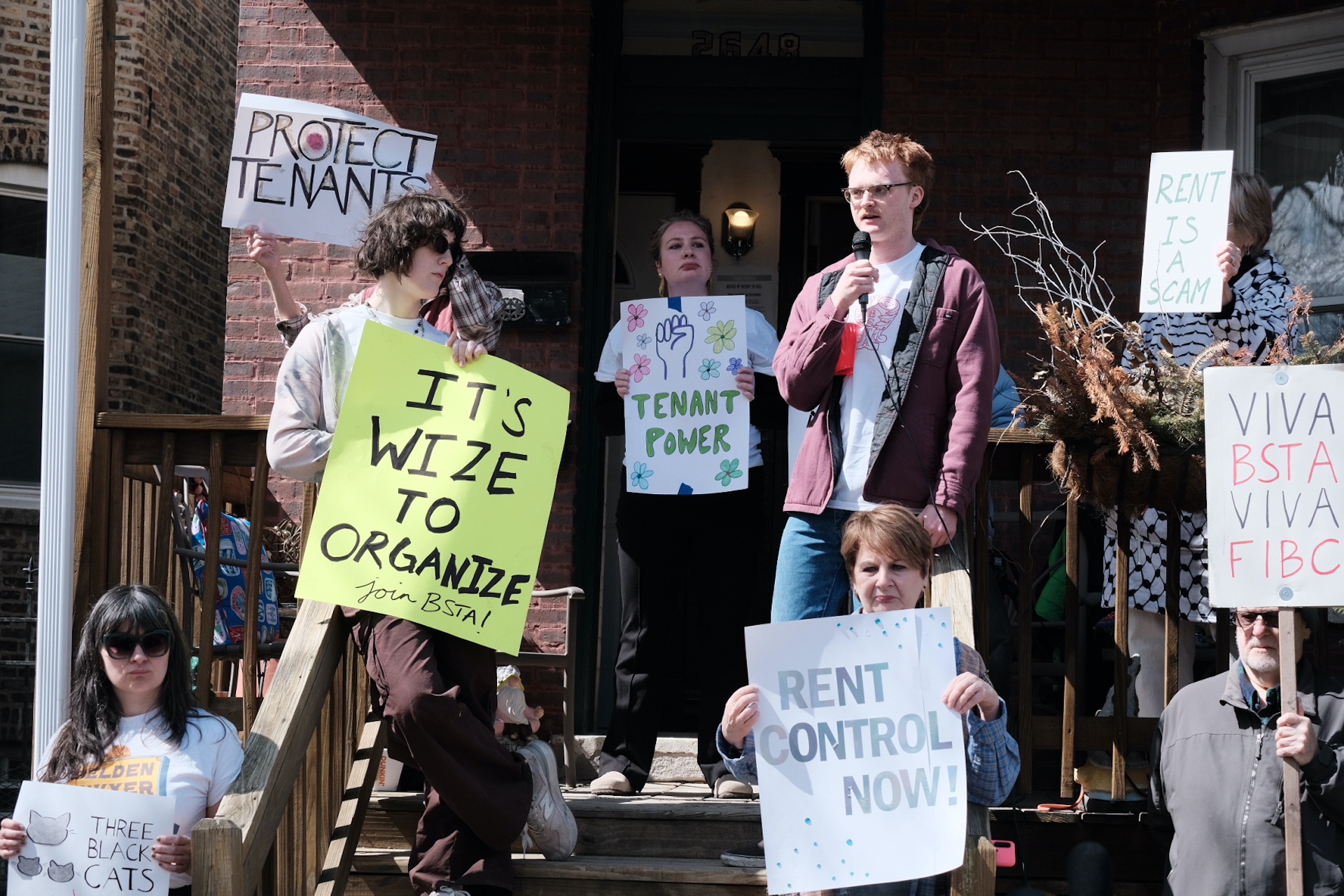
Three Black Cats Tenant Association member Tim Grandon speaks at a rally for tenants of 2648 N. Francisco Ave. on March 29, 2026. [Orian Sneor]
More than a year after an ordinance went into effect that aims to protect renters from being displaced from their apartments following a building sale, the law has seen little success, but a group of tenants in Logan Square are hoping to be the first such case.
The Northwest Side Housing Preservation Ordinance (SO2024-0011001), which went into effect in two phases in October 2024 and on March 1, 2025, upped the surcharge for demolishing residential buildings in most cases, disallowed the conversion of apartment buildings into single-family homes in areas that are mostly multifamily buildings and allowed the construction of two-flats by right in single-family zones in several neighborhoods on the Northwest Side.
Last March, the most controversial part of the measure, dubbed the Tenant Opportunity to Purchase Act (TOPA), went into effect in parts of Logan Square, Humboldt Park, Avondale, Hermosa and West Town. The program, which expanded on a policy instituted for some Woodlawn apartments in 2020, allows tenants to be given a preferential option to try to buy their building if their landlord puts it up for sale, a process also known as “right of first refusal.”
Since TOPA went into effect over a year ago, the Chicago Department of Housing (DOH) said three tenant groups have attempted to exercise their right of first refusal. Two have been unsuccessful, and another is in the middle of the process.
On April 6, the right of first refusal program will expand to include areas of Greater Grand Crossing, South Shore and Woodlawn. Though Woodlawn has had a version of the program since 2020 for many rental buildings with at least 10 units, the latest expansion removes that provision.
Under TOPA, a landlord must tell tenants and the city housing department of their intent to sell a building at least 30 days in advance for buildings with four or fewer units and at least 60 days in advance for buildings with five or more units.
After receiving a word from the landlord of a purchase offer from a buyer, tenants have a required window — depending on the building size — by which they can inform the property owner of their intent to match the third-party’s purchase offer and another window to secure financing and conduct due diligence before closing.
If the building has one or two units, a tenant or tenants have 75 days to close on a property, which consists of 15 days to formally exercise their right of first refusal and 60 days to conduct due diligence and close.
In buildings with three or more units, tenants must form an association and register with DOH in order to buy their building. DOH told The Daily Line that at least seven tenant associations have been formed under TOPA.
If the building has three or four units, the tenants have 90 days to close on the property, including a 30-day deadline to create a tenant organization and formally exercise their right of first refusal and 60 days to conduct due diligence. If the building has five or more units, they have 90 days to exercise that right and form the organization, with another 120 days to conduct due diligence.
Tenant groups in buildings with four or fewer units must provide a pre-approval from a lender to the owner in order to exercise the right of first refusal, and in buildings with five or more units, a group must provide a letter of intent from a lender or community organization in order to exercise the right.
The city encourages tenants to form their associations following the notice of intent to sell to be ready once the window to exercise their purchase right kicks in.
That’s the situation that the tenants of the five-unit building at 2648 N. Francisco Ave. are in right now. Brenna Townley, who is the designated officer of the Three Black Cats Tenant Association, the building’s tenant association, said the group is sort of in limbo until they receive notice that their landlord — who put their building up for sale in January — gets an offer.
Townley described the process of getting their organization registered and certified as fairly straightforward. As a smaller building, she said it was also pretty easy to get the majority of the building onboard with the purchase possibility, a requirement for forming the association.
The real hurdle, she said, is scrounging up enough to potentially buy the property, which has been listed for over $1 million.
“Support such as … capital, a fund that people can get their hands into to help with a down payment, has not existed,” Townley said. “It’s something that we’re calling for immediately.”
TOPA also gives tenants the right to transfer their right of first refusal to a third-party that is interested in buying the building and maintaining the rents to allow existing tenants to stay.
Townley said that party could include a wealthy benefactor or a community land trust.
“If you don’t have money as a tenant association, the biggest thing that TOPA gives you is time,” Townley said. “It slows down the selling process, which means you have more and more time to stay in your landlord’s good will, to negotiate with your landlord [and] to make a list of demands to your landlord.”
Nicholas Katsafados, a local housing provider who owns at least five buildings within the northwest TOPA boundaries — but not Townley’s — said he thinks the ordinance has created a cumbersome process that discourages building sales and stifles housing production at a time when the city needs it.
“If [you expected to have] people attacking you for selling your property after 20 years, would you be particularly motivated to deal with those people or that potential situation, if you were about to sell or going to sell in the near future?” he said. “Probably not.”
He took the lack of success by tenant organizations as evidence that the ordinance was “ill-conceived” for all affected.
“It’s not a surprise to me that it's failing, and if it's not succeeding in helping the tenants buy, then why do we have it here, other than to just make the process more difficult for the purposes of buying and selling,” Katsafados told The Daily Line.
Tom Benedetto, senior director of local advocacy with Illinois REALTORS, said in a statement the ordinance forces both "residents and prospective buyers ... to navigate a highly technical, time-sensitive process that hinders more than helps these neighborhoods."
A few months after it became law, two aldermen — Alds. Gilbert Villegas (36) and Felix Cardona (31) — passed an ordinance pulling their wards out of the program.
Related: Aldermen put forward ordinance to pull their wards from anti-gentrification law
At the time, Villegas said he was concerned that owners may have to sell their properties for less than market value and that the law would also lengthen the process for selling a property and create issues for owners that need to pay back or refinance a loan.
DOH said since last March, the city has received notice of at least 217 completed sales or pending listings under the ordinance.


