


-
SEP 24, 2025

UNLOCKEDQuinn, Lawson reach compromise on ordinance to broadly legalize conversion units and granny flats citywide with special carveouts for single-family zones
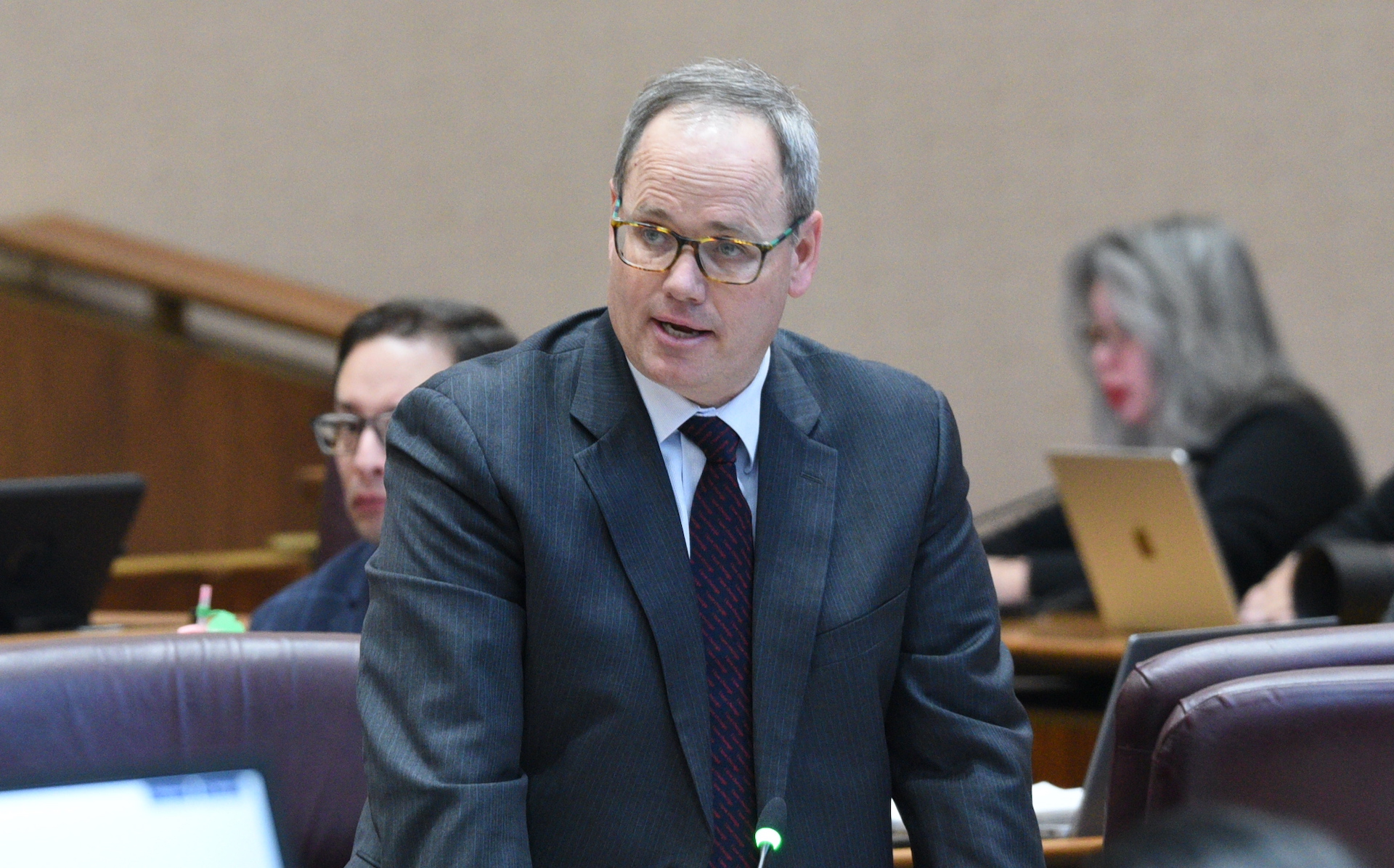
Ald. Marty Quinn (13) is pictured during a City Council meeting on January 15, 2025. [Don Vincent/The Daily Line]
A prominent opponent of recent attempts to legalize additional dwelling units (ADUs) citywide has come to a compromise with the lead sponsor of the ADU legalization ordinance, signaling potential passage at this Thursday’s City Council meeting.
Southwest Side Ald. Marty Quinn (13) was against previous versions of the Ald. Bennett Lawson’s (44) ADU ordinance because of the potential impact on the character of single-family neighborhoods where new attic and basement conversions and coach houses would be allowed.
Related: Council could take final vote on citywide expansion of coach house, conversion unit program
The version of Lawson’s ordinance that was approved by the Committee on Zoning, Landmarks and Building Standards in July would have expanded the allowance of ADUs citywide by legalizing them in all residential zoning districts by right and in many business and commercial zones. The ordinance would allow conversion units to be added to residential buildings that have been standing for at least 20 years.
To try to address concerns from council members worried about the impact on single-family neighborhoods, the ordinance was amended to add annual limits on the number of units in each residential zone and a limit on who could build ADUs in any zone. In RS1, RS2 and RS3 zoning districts, ADU construction by-right would have been limited to one, two and three units per block face and opposing block face each year, respectively. Additionally, if an ADU was being sought on a lot with a detached house, the home would have to be owner-occupied.
Both of those provisions could have been opted out of by individual alderpeople for their own wards.
Even with those compromises, the ordinance only passed the zoning committee by a 13-7 vote and was quickly deferred using a procedural maneuver by Quinn and Ald. Greg Mitchell (7) at the City Council meeting the following day.
Related: Chicago City Council delays ADU expansion
A revised ordinance (SO2024-0008918) will be considered at the upcoming council meeting. The revised proposal would not allow ADUs in most single-family, or RS, zoning districts unless the City Council votes to opt individual wards into the program. Multi-family residential zones would still allow them by right.
In addition, the revised ordinance would also maintain allowances for ADUs in the RS zones covered by the five ADU pilot program areas established in 2021. ADUs would be subject to the same annual limitations and owner-occupancy provision previously proposed for the West, South and Southeast pilot zones while exempting the North and Northwest zones from those limits.
Finally, the revised ordinance would require coach house construction to be done by contractors that participate in a U.S. Department of Labor-approved apprenticeship program, according to the ordinance.
“I feel this revised ordinance better represents Chicago’s values by lifting up our labor unions and workers,” Quinn said in a news release. “I can stand by an ordinance that encourages local hiring and fair wage standards, a point that resonates strongly with Chicago's labor community. I appreciate Ald. Lawson’s collaboration and partnership to move this ordinance forward.”
“This agreement represents a significant step forward for housing in neighborhoods throughout the city,” Lawson said in the news release. “We listened to residents, developers, and our labor partners to craft an ordinance that not only expands housing choices but also creates good-paying jobs right here in our communities. I thank Ald. Quinn for his partnership in finding a strong and effective path forward.”
Other provisions of the ordinance passed by committee in July remain, such as allowing ADUs in all “B” zoning districts and in the C1 and C2 districts, permitting coach houses and conversion units by right in B2 and permitting coach houses by right in C1, C2 and all other B districts.
Outside of the B2 district, conversion units would be allowed by right below the second floor of a building if at least 40 percent of the ground floor space fronting the public way is still devoted to commercial use. Otherwise, a special use permit would be required for a conversion unit in those zones.
The ADU ordinance allows buildings to add a number of conversion units that don’t exceed 33 percent of the existing non-ADU dwelling units, and residences with a single dwelling unit would be allowed to add just one conversion unit. In practice, that means buildings with four or fewer dwelling units may build one additional unit max. Buildings with five or more dwellings may build more up to that 33 percent threshold.
The ordinance also allows coach houses to be set up in business and commercial zones in the rear 30 feet of lot depth.
The measure also removes the prohibition on building a coach house and conversion units on the same lot and allows administrative adjustments to waive the requirement to maintain existing accessory parking when building a coach house.
When two or more ADUs are added to a property, every other unit would need to be designated as affordable to households making up to 60 percent the area median income for a 30-year-period after its construction, as the code currently requires. ADUs would also be banned from being used as short-term rentals.


